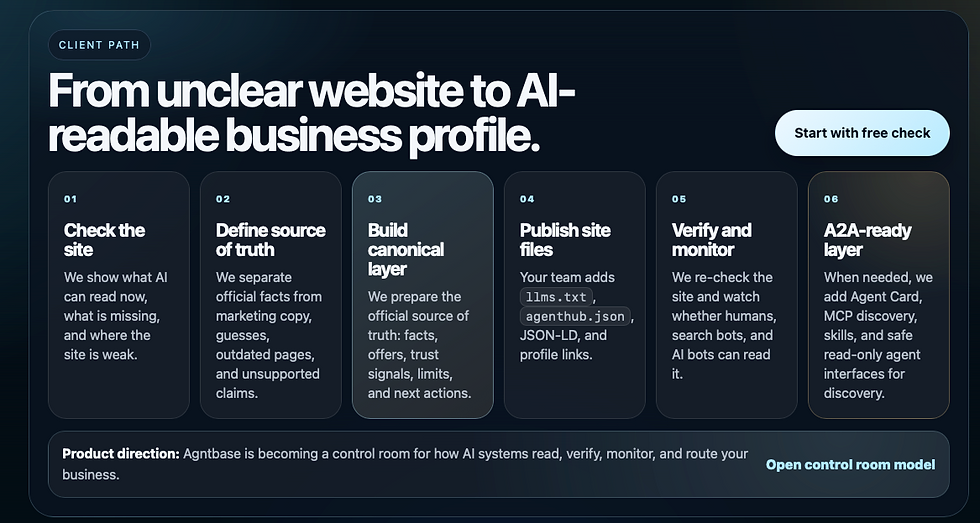
Ensuring your site is eligible for AI Search.
By combining Entity Optimization, Data, Content, and Digital PR we ensure AI platforms understand and recommend your brand.


Agntbase provides an AI Readiness setup for businesses.
They provide the structure to make your business understandable to AI.
To maximize your visibility in search, it’s essential to define entities clearly and consistently across your site.
Strategy is where we spend the time!
What Makes This Different
Most solutions:
-
Deploy basic schema types
-
Focus on plugins
-
Ignore entity architecture
We focus on:
-
Custom schema
-
Entity-first optimization
-
AI visibility
-
Content reformatting when necessary
-
Long-term semantic infrastructure
We've Automated Schema!
Step 4: AI Validation + Architectural Review
Before deployment, we assess:
-
Entity confidence
-
Structural integrity
-
AI retrieval clarity
-
Competitive gaps
Step 5: Monitoring + Optimization
We track:
-
Rich results
-
AI Overview inclusion
-
Impressions
-
Click-through rate
-
Knowledge graph evolution
-
Competitive positioning
Be canonical -- be included.
Step 1: Entity Assessment
We identify, define, and normalize the core entities across your site.
Step 2: Knowledge Graph Development
We build a custom, reusable content knowledge graph aligned to your business goals.
Step 3: AI-Assisted Schema Authoring
Our platform generates advanced JSON-LD markup mapped to your entities and intent.
There is a new failure mode in search:
-
Not penalties.
-
Not ranking drops.
-
Exclusion.
-
Brands aren’t being demoted.
-
They’re being bypassed.
If we cannot improve the clarity of your content, we won’t take the project.
Schema without clarity creates a false sense of progress.


Schema in AI Search: What You Need to Know
-
Schema.org is the standardized vocabulary for structured data.
-
JSON-LD is the preferred implementation format.
-
Common schema types are only the starting point.
-
Custom entity mapping is where real advantage begins.
-
Schema is not a ranking factor.
-
But it is an accessibility factor.
If AI systems cannot parse and trust your content, you are invisible.
The Outcome
When implemented correctly, schema:
-
Increases inclusion in AI-driven search
-
Strengthens entity recognition
-
Improves content reuse in generative systems
-
Builds durable semantic equity

AI Does NOT Reward Decoration. It Rewards Clarity. And Clarity Requires Structure.
I'm including this in the Schema section because this will be such a HUGE shift and happen quickly, and structure is essential. In 2028, advertising inside AI systems will mature into conversational placements embedded within answers. This is a HUGE shift.
From a student and consumer perspective, there will be no “organic vs paid.” There will only be: “What my assistant recommends.” GEO drives trusted inclusion. Paid reinforces high-intent visibility. They will operate as one system. Paid will increasingly amplify GEO rather than replace it. Institutions must prepare now for a fully integrated full-funnel strategy.